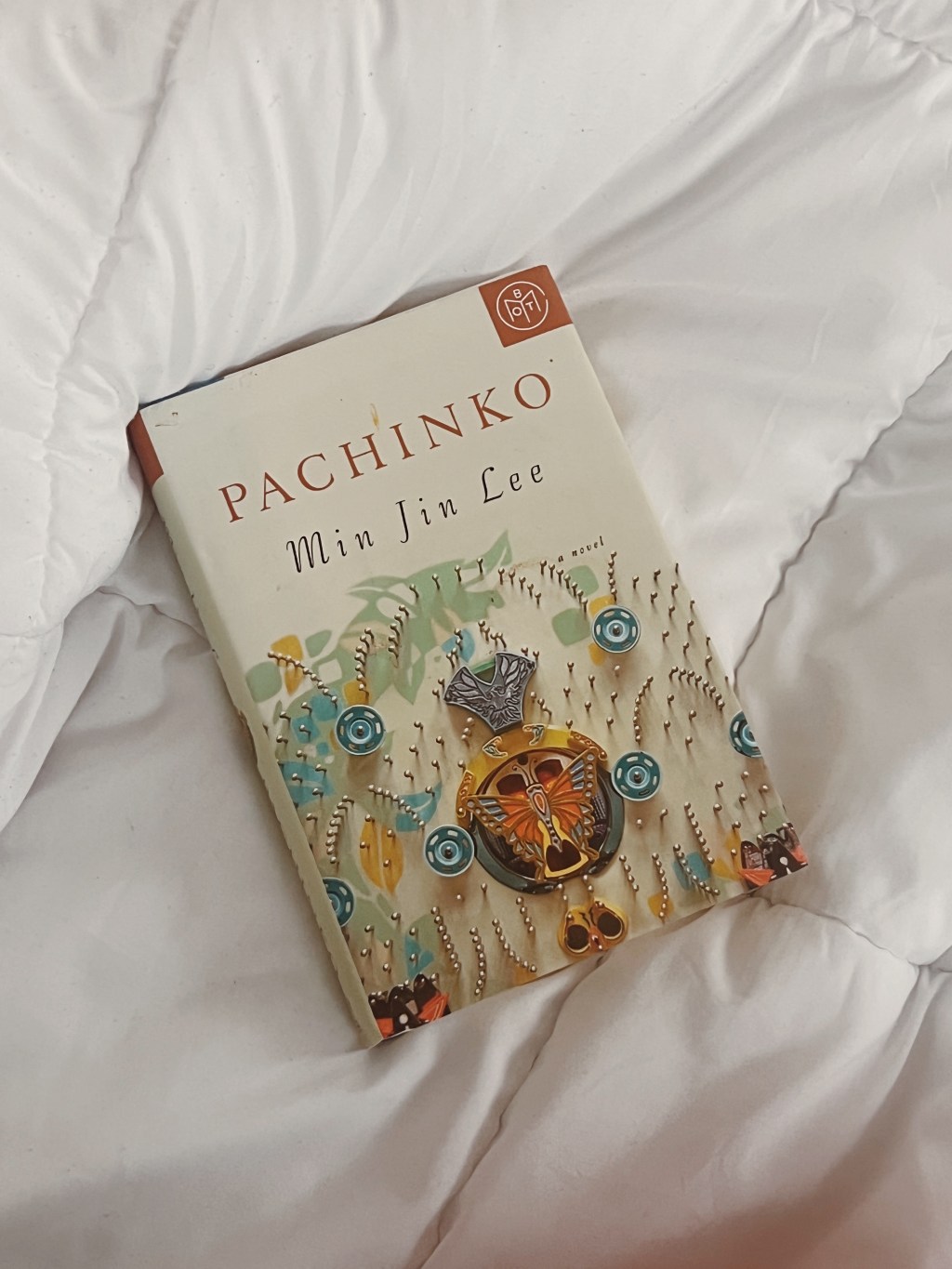
I received this book in a subscription book box over two years ago and I started it, but it felt too serious at that time, so I put it down. But decided to pick it back up this year, and started the book all over again. I am not sure what made me ready to finally start the book. But I am glad I did.
What I really appreciated about this book was the history of the Korean-Japanese conflict. I am ashamed to say, I knew nothing of this dynamic and it was interesting and sad at the same time. That people, who from the outside, are similar in looks and culture could have this wide of a division. But I also understood the differences that might seem grander than the similarities. because as a Ghanaian, I can see people on the outside looking at Africans and wondering how different they can be, that there is deep disdain for each other. But alas, colonization affected us all.
Anyways about the book!
I couldn’t have imagined what Sunja had signed up for when she started having a relationship with Hansu. Hansu was too slick to not be trouble. But knowing that he was deeply in love with Sunja made me hopeful, but then it quickly went downhill from there. Sunja showed such great character by choosing not to be Hunsu’s side-chick and stuck to her guns. Isak was such an angel for marrying Sunja especially during that time and what could have become of Sunja and her family had she stayed in town. I wept for Yangjin when Sunja and Isak left for Japan. From then on, the whole story became one tragedy after another.
The conditions as the author described of the treatment of Koreans in Japan was heartbreaking. Being hard working and not being paid their worth, being secluded to the slums, the persecution of christians, and everything else the oppressor does to dehumanize individuals. It was heartbreaking that Isak had to go through what he went through for being such a kind man. But I am glad he got to see his kids before his death. I also thought his brother stepping up to take care of Sanju and her kids was very noble.
What I found a bit fascinating, something that has stood the test of time, is men’s ability to make women the bad guys for helping them. In the book, we find out that Isak’s brother borrowed money for him to come to the country and the funds had incurred over 100% in interest. When Sunja heard of this, she sold a watch given to her by Hansu to pay off her brother-in-law’s debt. Instead of him saying thank you, he rather chastised her. Speaking of the watch, I thought Hansu was out of the picture for good, and the way the author introduced him back to the story was skillfully done. If Hansu and Sunja were going to meet at all, I thought it would be them running into each other at some market but to use the watch to reunite them was just so good. I also liked how Hansu worked behind the scenes to be there for Sunja and her family up until he revealed himself to her at his restaurant.
With all the Korean and Japanese conflict expressed in the book, I found that money speaks as a universal concept. Because the way Hansu was accepted by the Japanese people solely because he had connections and knew had to make them money and he was rich himself. Reminds me that money truly rules everything around us.
I think the author did a good job of explaining the difference between being a good Korean and a bad Korean according to the Japanese by using Noa and Mozasu as the example. This is so evidence among oppressed people, where the more you assimilate and want to be like your oppressor the more you are accepted. When Noa and Mozasu were in their teenage years, I felt like that was when the author started speeding up and jumping around with the story.
In doing so, so many topics went on unresolved and not expanded on. For example Mozasu dropping out of school and all of sudden becoming successful in the Pachinko world. I wish we would have gotten more details about how he ran his business. Also, I think throughout the book, there were bits and bobs about how owning a successful Pachinko was inherently unethical. I get that the author was trying to get us on the side of the main characters, but it showed very little about how Mossazu ran his business, and I was curious.
Noa’s Japanese university girlfriend pissed me all the way off. It really showed the dynamic between even the so-called “accepting” Japanese and how they still looked down on the Koreans.
Noa getting upset and quitting school was one of those things I struggled to understand that I am hoping to look into further. Midway through the book, we are almost certain that Hansu is some kind of corrupt guy that is not an upstanding citizen. No one wants a family member like that, I understand. But Noa’s reaction was so over the top, I think that’s what I didn’t get a clear understanding on. In that way, I feel like he had really adopted the Japanese thought as described in the book, that your blood can be tainted. So just by sharing Hansu’s blood, he was not a worthy person. My confusion was or is, that he was raised by people he respected, so why couldn’t he rely on that and attach his identity to them. I think that is what I wanted clarity on from the author. Is it a cultural thing many Koreans believe?
Also, Mozasu’s gay friend and wife? What was even the point?
Noa’s suicide wrecked me. His ability to live like a Japanese man for those many years, knowing very well, everyone in that community would have rejected him had they found out his true identity. As I am writing this, it has dawned on me that his actions were very similar to Hansu and Sunja. He was upset that Hansu was his father based on his identity, but essentially, he did that with his children and wife. I wish the author would have given us more insight into why Noa killed himself. I think it was implied that it was by seeing the mother, but I am guessing it would be deeper than that.
Overall, when all the men in the family ended up at Pachinkos, it felt like giving up. For all of them, it was the last resort. Almost like running a Pachinko was their fate and so they just accepted their lot. I wish Solomon had chosen a different direction and not let one disappointment defeat him and just give up on his dreams. But at the same time, with how things were, the kind of issue Solomon had with his co-workers would have kept going because he was Korean and with a corporate job, a Japanese would have always been his boss. I think sometimes, the only way one can preserve their dignity is by making choices that may not even be appealing to the ordinary person.
I thought it was a good book, my only critique was it got a bit jumpy the last half of the book. And there were so many characters to keep up with. I joked on my Instagram page that I needed one of those Nick Cannon family tree diagrams.
I will rate the book a 4 star because it made me think. It led me to do additional research outside what I read. I am now all the way in a rabbit hole regarding WWII, the split between the Koreas, and the Japanese and Korean relations. I also wonder if the other Northern Asian countries are a part of it all. There was a mention of the Chinese, but I don’t know to what extent. Anyways, overall a good book. I would definitely recommend it.


Leave a Reply