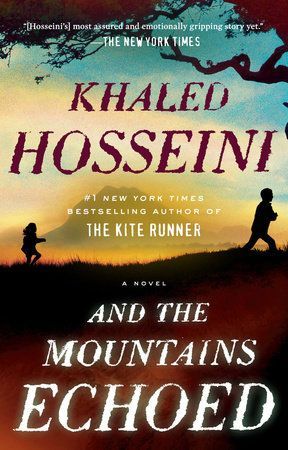
Judging a book by its cover
I didn’t care too much about the cover. A dear friend of mine recommended it and I trust her book choices so I picked it up. But if you’ve read the Kite Runner, seeing Khaled Hosseini’s name on the book will be enough reason for you to pick it up.
Synopsis from goodreads.com
So, then. You want a story and I will tell you one…Afghanistan, 1952. Abdullah and his sister Pari live with their father and stepmother in the small village of Shadbagh. Their father, Saboor, is constantly in search of work and they struggle together through poverty and brutal winters. To Abdullah, Pari – as beautiful and sweet-natured as the fairy for which she was …more
My Thoughts
This book was messy. If you are familiar with Kite Runner and A Thousand Splendid Suns, And The Mountains Echoed was nothing like those two. I’ve always loved Khaled Hosseini style of writing and the character development but this just appeared to be so unlike him. Maybe he was trying something different. Who knows?!
I have read books by authors who time travel and change geographical locations with every chapter, and I noticed that is what Hosseini was attempting to do, but it didn’t feel seamless. I almost wished the stories would have been made into a collection of short stories. Granted, readers eventually connect all the characters together but it just took too long.
Initially, I thought the book was going to be heavily focused on Pari and Abdullah’s brother sister relationship as Hosseini is good at doing. For example in A Thousand Splendid Suns, the mother daughter relationship was given the attention it needed and similarly to Kite Runner. But here, what I thought were the main characters and main storylines was just another random story. I am not sure if this book even had a plot. There was an over emphasis on minor characters that we had forgotten about, some of the ties were not explained well, there were incomplete stories, all these made the book difficult to read. That said, Hosseini really exposed so many complexities that we deal as humans so beautifully and tragically.
Nabi and Suleiman
- Imagine having to suppress the love you have for someone your entire life and yet being so closed to them. Hosseini doesn’t explicitly say why they couldn’t live out their love story but I think we can deduce, from looking at modern Afghanistan that being homosexual is frowned upon. I cherished how Nabi stayed by Suleiman’s side for his whole life even after discovering that Suli was interested in him. I think once the shock fell off, he discovered he loved him too. I think there is something special about relationships where there is deep love and affection but isn’t romantic. I think we’ve been conditioned to believe that deep love can only be found in romantic relationships and I do not think that is the case. I think Hosseini is so good at giving us a different view on love and loyalty.
Idris and Roshi
- I was so invested in the story and then it just ended. How many of us are like Roshi though? We have good intentions and everything in our heart convinces us that we are going to stick to this thing and see this thing through till the very end. But then life happens. We get caught up in our daily routines, the good deed we wanted to do becomes all of a sudden too daunting of a task to make happen.
Marko and Thalia
- This was my absolute favorite story. Marko’s disdain for Thalia’s look is something at first read, you’re just like what an ass. But then you realize, how many of us can’t stare at a disfigured face for a long time. I have seen someone feeding through a tube in their neck and I couldn’t look. I had to get up because I was so uncomfortable by the whole situation and I can imagine that is how Marko felt. But the way their story developed was so real. I loved the count down Hosseini included when Marko was going to take a picture of Thalia. I resonated with Marko’s desire to just leave, leave the smallness, leave the ordinary. But I also understood Thalia’s need for stability, familiarity and home. A few years back, I would say, everyone needs to leave their small town, but I have realized that there isn’t a good way or bad way to live. There is a right way to live for yourself and to do right by you. Another example of a deep loving relationship that isn’t supported by romance.
Pari and Abdullah
- I have never wanted a fairy tale ending so badly. Throughout the whole book, even as I was reading the stories of others, my mind was on Pari and Abdu and how epic their reconnection was going to be. That is what kept me turning the pages. I had such high hopes. How they were separated was so painful and their reunion, if I can call it that was even more painful. I wanted just for one second, Abdu to remember Pari, the sister he has been waiting for his whole life. This bit was so cruel and I shed a few tears.
I can’t rewrite the whole book here, but these are the stories that stood out to me the most. I maintain that this book should have been a book of short stories. It would have been so powerful. But I also think it would have been entertaining if the book had a map, tying all the people together. Or I could have done it by myself, but I am no longer in school and I don’t need to do that kind of work.
Does the title fit the book?
I don’t get why the book was called what it was called. But I did a little research and Khaled Hosseini said that it was inspired by a William Blake’s poem called Nurses Song: Innocence. There was also a mention about generations of mountains in Afghanistan.
Quotes that stood out to me
“It’s a funny thing… but people mostly have it backward. They think they live by what they want. But really, what guides them is what they’re afraid of. What they don’t want.”
“All good things in life are fragile and easily lost”


Leave a Reply